

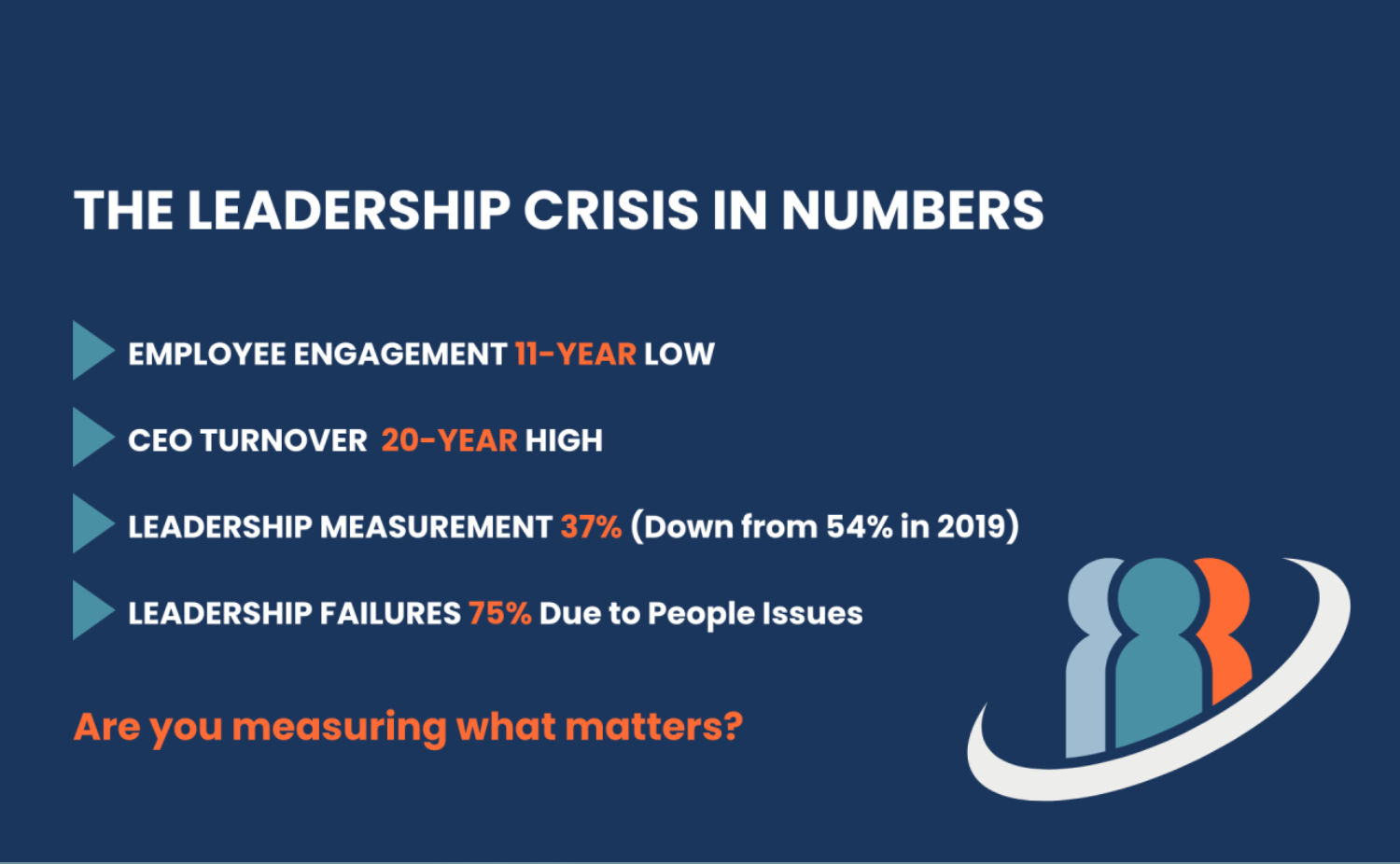
Employee engagement just hit an 11-year low. CEO turnover reached a 20-year high. Yet 91% of leadership development budgets still focus on strategy and operations, not leadership effectiveness.
We’re solving the wrong problem.
The Great Leadership Disconnect of 2024
Here’s what the data reveals: while companies pour millions into strategic planning and operational excellence, they’re systematically underinvesting in the one factor that drives everything else—leadership trust.
Gallup’s latest research shows that confidence in leadership is the top driver of employee engagement, yet the percentage of companies measuring leadership effectiveness dropped from 54% in 2019 to just 37% in 2024.
We’re avoiding the conversations that matter most.
What the Research Actually Shows About Leadership Failure
Multiple studies converge on a startling truth about why leaders fail:
- Harvard Business Review’s analysis of executive derailment found that 75% of leadership failures stem from interpersonal issues, not strategic incompetence.
- Gallup’s State of the Global Workplace reveals that managers account for 70% of variance in employee engagement scores.
- McKinsey’s research on organizational health demonstrates that companies in the top quartile for leadership effectiveness are 2.3x more likely to outperform financially.
Yet most boards can’t even define what effective leadership looks like in their organization.
The Three Fatal Leadership Patterns Destroying Companies
1. The Isolation Cascade
The pattern: Leaders become increasingly removed from operational reality as they climb hierarchies. Information gets filtered, problems get sanitized, and decisions get made on incomplete data.
The cost: By the time critical issues reach leadership, they’ve become crises. Netflix’s Qwikster disaster, JCPenney’s pricing strategy failure, and countless other corporate missteps follow this exact pattern.
The fix: Systematic direct feedback loops that bypass hierarchical filters.
2. The Initiative Overload Syndrome
The pattern: Leaders launch multiple “transformational” programs simultaneously, believing more change equals more progress.
The research: Change management studies show that organizations can effectively handle 2-3 major initiatives simultaneously. Beyond that, success rates plummet below 30%.
The cost: Initiative fatigue makes employees immune to actual necessary changes. When everything is a priority, nothing is.
3. The Performance Theater Trap
The pattern: Leaders optimize for metric performance rather than underlying health, creating elaborate reporting systems that hide problems rather than solve them.
The evidence: Wells Fargo’s fake account scandal, Volkswagen’s emissions fraud, and Boeing’s 737 MAX crisis all demonstrate what happens when performance theater replaces authentic leadership.
The Leadership Behaviors That Create Resilient Organizations
Research from Harvard Business School, Wharton, and Stanford converges on three critical leadership capabilities:
1. Radical Transparency (With Strategic Communication)
What the research shows: Companies with transparent communication practices have 30% higher employee retention and 40% lower turnover costs.
What it means: Consistent truth-telling about challenges while maintaining confidence in solutions. Not sharing every uncertainty, but never hiding known problems.
The Netflix principle:When Reed Hastings publicly admitted the Qwikster mistake and took full responsibility, subscriber trust actually increased. Transparency built credibility rather than destroying it.
2. Decision Velocity Over Decision Perfection
Amazon’s 70% rule: Jeff Bezos famously advocated making decisions with 70% of desired information rather than waiting for 90%, because the cost of being slow exceeds the cost of being wrong on reversible decisions.
Why this matters now: In rapidly changing markets, decision speed often trumps decision quality. Your competitors aren’t waiting for your perfect strategy.
The implementation framework: Categorize decisions as reversible (make them fast) or irreversible (invest more time). Most decisions are reversible.
3. Culture Guardianship Over Culture Management
The Salesforce model: Marc Benioff’s obsession with V2MOM (Vision, Values, Methods, Obstacles, Measures) isn’t corporate theater—it’s operational doctrine that guides every major decision.
What elite leaders do differently: They fire high performers who violate cultural values. They promote based on values alignment combined with results, not results alone.
The research backing: Companies with strong, consistently enforced cultures outperform peers by 2.5x in stock returns over 11 years, according to Harvard Business School research.
The Leadership Assessment Framework
Based on extensive organizational research, these diagnostic questions predict leadership effectiveness:
Organizational Intelligence:
- How many hierarchical levels exist between you and your front-line employees?
- What percentage of your information about company operations comes from direct observation vs. reports?
- When did you last change a significant decision based on employee feedback?
Decision Architecture:
- What’s your average time from problem identification to solution implementation?
- Do your teams describe your decision-making criteria as predictable or inconsistent?
- How many decisions have you reversed in the past year due to new information?
Cultural Alignment:
- Would employee surveys of your culture match your self-assessment?
- Have you ever terminated a high performer for cultural violations?
- Do your promotion decisions surprise employees, or do they align with stated values?
The Board-Level Conversation Every CEO Needs
Research from governance studies shows successful CEO-board relationships share these characteristics:
Leadership Effectiveness Metrics
Beyond financial metrics, high-performing boards track:
- Employee engagement trends by division
- Leadership pipeline strength and succession readiness
- Decision implementation speed and effectiveness
- Cultural health indicators
Succession Planning Reality
Current reality: BoardProspects research shows 70% of boards lack confidence in their internal succession pipeline. Required evolution:Active leadership development with measurable competency tracking.
Crisis Leadership Preparedness
Studies of crisis management effectiveness show that leadership team unity during adversity predicts recovery speed better than financial reserves or market position.
The Evidence-Based Leadership Reset
For leaders ready to evolve their approach:
Assessment Phase (30 days)
- Anonymous 360-degree leadership effectiveness surveys
- Direct employee feedback sessions across organizational levels
- Decision audit: speed, quality, and implementation success rates
Behavioral Evolution Phase (60 days)
- Implement systematic feedback mechanisms that bypass hierarchical filtering
- Establish decision-making frameworks with clear timeboxes
- Begin modeling transparency behaviors consistently
System Integration Phase (90 days)
- Create accountability structures for leadership behavioral change
- Develop leadership effectiveness metrics beyond financial performance
- Build systematic leadership development programs
The Future of Leadership Excellence
The data is clear: The half-life of business strategies is shrinking. What worked for five years now works for 18 months. The leaders who survive won’t be those with the best plans—they’ll be those who can adapt plans fastest while maintaining organizational trust and alignment.
Companies that thrive will be led by executives who understand that leadership effectiveness isn’t about being right—it’s about creating organizations that can rapidly get to right answers together.
The Bottom Line
Employee engagement has hit an 11-year low. CEO turnover has reached a 20-year high. The connection isn’t coincidental.
Organizations are experiencing a leadership crisis, but they’re treating it as an employee problem. They’re investing in engagement surveys while their leaders remain isolated from reality. They’re launching culture initiatives while promoting people who violate stated values.
The companies that emerge stronger will be those whose leaders embrace this fundamental truth: In an era of unprecedented change, authentic leadership isn’t a soft skill—it’s a competitive advantage.
The question isn’t whether your organization needs better leadership. The question is whether you’ll develop it before your competitors do.
What leadership challenges are you seeing in your organization? How are you measuring leadership effectiveness beyond traditional metrics?
Share this if you believe leadership development deserves the same investment as strategic planning.



What do you think?
This strategic reallocation of resources can help companies create a significant competitive advantage.
Comments are closed.